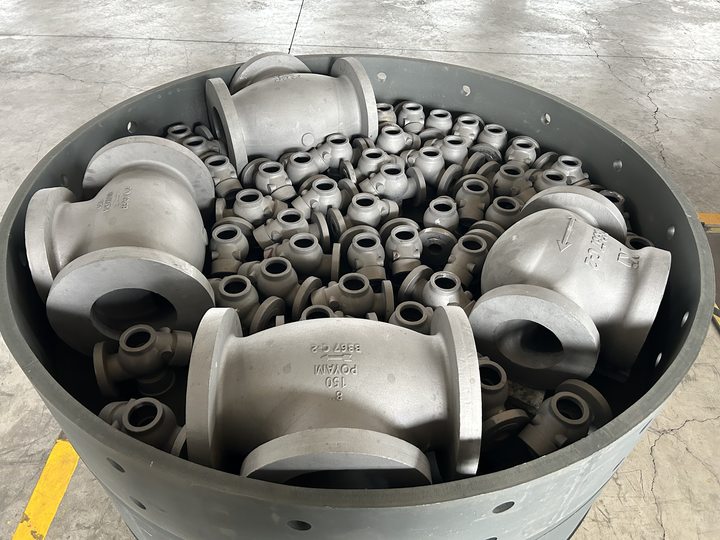
Hot Isostatic Press (HIP)
Hot Isostatic Pressing(HIP)for Titanium Castings
Introduction to HIP
Hot Isostatic Pressing(HIP)is a manufacturing process that combines high temperature and high pressure to enhance the mechanical properties and structural integrity of metal components.It was originally developed in the 1950s for diffusion bonding applications in the nuclear industry but has since become a critical process in the manufacturing of titanium castings,especially in the aerospace,marine,and biomedical industries.
How HIP Works
During the HIP process,parts are placed in a sealed chamber and subjected to high temperatures(typically up to 920°C)and high isostatic pressures(up to 120 MPa)using an inert gas,usually argon.The combination of heat and pressure effectively closes internal pores and shrinkage cavities,reducing porosity and increasing the density of the material.This process can eliminate defects such as internal voids and improve the overall mechanical performance of the castings.
Applications of HIP in Titanium Casting
- Aerospace Industry
Titanium alloys,such as Ti6Al4V,are widely used in aerospace components due to their high strength-to-weight ratio,excellent corrosion resistance,and high-temperature performance.HIP is used to eliminate internal defects and improve the mechanical properties of these components,ensuring they meet stringent performance and safety standards.Examples include turbine blades,structural frames,and engine components.
- Marine Industry
Titanium castings are used in marine applications for their corrosion resistance and durability.HIP helps in enhancing the structural integrity of these components,making them suitable for long-term exposure to harsh marine environments.
- Biomedical Industry
Titanium alloys are biocompatible and are often used in medical implants such as hip and knee replacements.HIP ensures that these implants have high strength,low porosity,and improved fatigue resistance,which is crucial for their long-term performance in the human body.
Benefits of HIP for Titanium Castings
- Improved Mechanical Properties
HIP significantly enhances the tensile strength,yield strength,and ductility of titanium castings.It also improves resistance to fatigue,impact,and wear,making the components more reliable in high-stress applications.
- Defect Reduction
The process effectively eliminates internal shrinkage cavities and porosity,which are common defects in casting.This results in a denser and more uniform microstructure.
- Design Flexibility
HIP allows for the production of complex geometries with near-net shapes,reducing the need for extensive machining and lowering production costs.
- Consistency and Quality
The uniform application of pressure ensures consistent results,even for components with intricate shapes.This leads to higher quality and more reliable parts.
HIP Process Parameters
The effectiveness of HIP depends on the specific parameters used,including temperature,pressure,and duration.For example,studies have shown that increasing the temperature and pressure can significantly reduce internal defects and improve microstructural uniformity.Optimal parameters for titanium alloys such as Ti6Al4V are typically in the range of 900°C to 950°C and pressures above 120 MPa.
Case Study:HIP on Ti6Al4V Alloy
A study on the effect of HIP on Ti6Al4V alloy with millimeter-scale shrinkage cavities demonstrated that HIP can effectively close these cavities through plastic deformation.The microstructure in the closure region evolves significantly,with the formation of new grain boundaries and the breakdown of α-lamellae.The mechanical properties,such as yield strength and tensile strength,improve initially and then stabilize with increased HIP duration.
Conclusion
Hot Isostatic Pressing is a crucial process for enhancing the quality and performance of titanium castings.By eliminating internal defects and optimizing microstructural properties,HIP ensures that titanium components meet the highest standards of reliability and durability.This process is essential for industries where failure is not an option,such as aerospace,marine,and biomedical applications.